

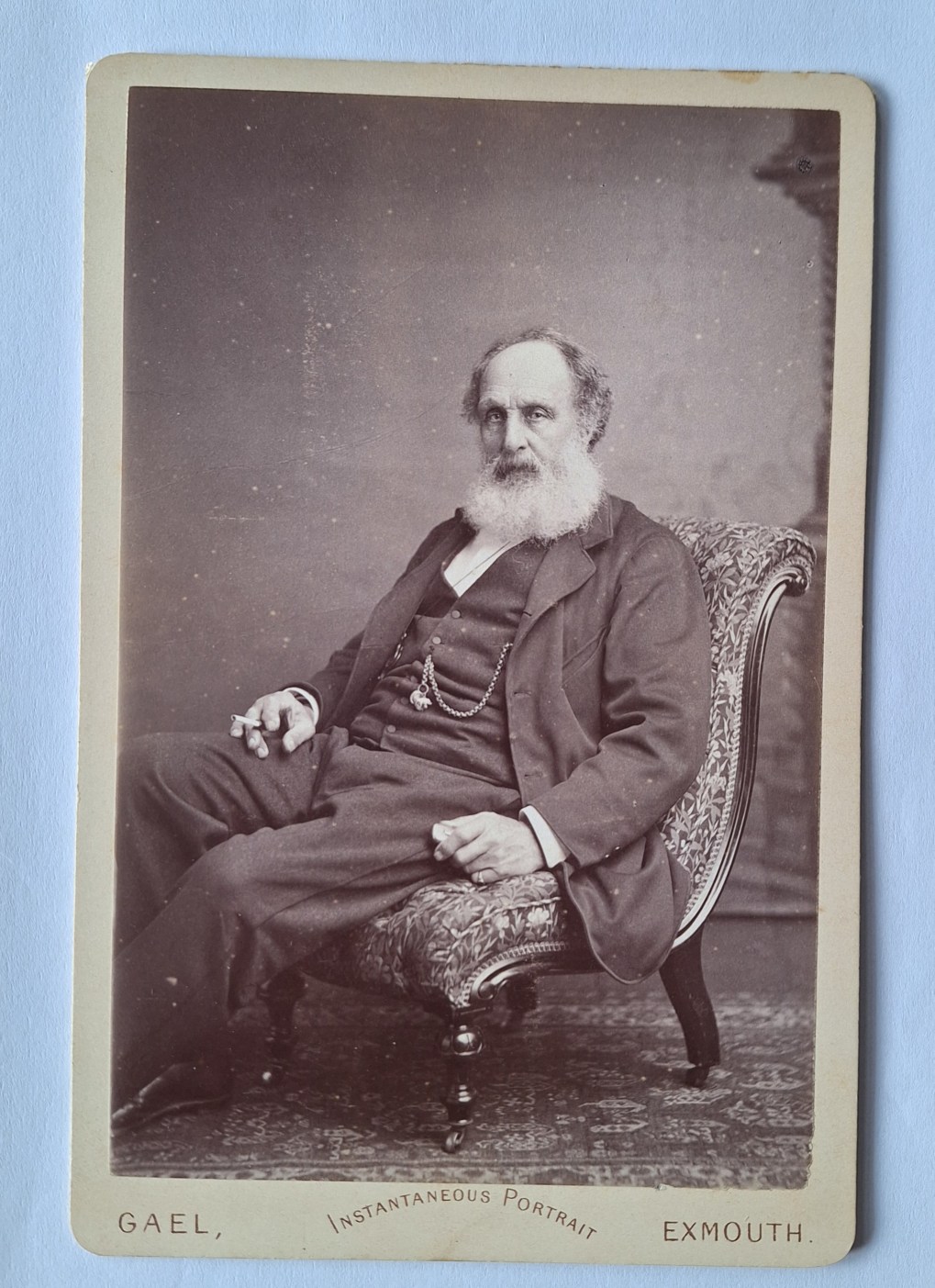
[Cabinet card of William Hugh Dobbie by Edgar Gael, Exmouth. Collection of Fabiënne Tetteroo.]
Among William Hugh Dobbie’s papers now held at the Caird Library of the National Maritime Museum Greenwich I saw three photographs of him, including one carte de visite and one cabinet card. Not really expecting to find anything, I searched for the CDV and cabinet card on auction sites. To my pleasant surprise I saw the cabinet card of Dobbie on offer, being described as a photo of an unidentified “old man with cigarette”, which I was able to buy. Who was this Dobbie and why am I interested in him?
Born on 6 January 1812 in Great Saling to Captain William Hugh Dobbie RN and Agatha, William Hugh Dobbie junior followed in his father’s footsteps when he joined the Royal Navy in 1825 or 1826. His first ship was HMS Pyramus, where he met James Fitzjames. According to his recommendation letters [DBB/103], Dobbie was on the Pyramus from 17 June 1826 until 15 September 1828. Years later he would again be on the same ship as Fitzjames, when they both joined gunnery training ship HMS Excellent. Dobbie was there from 22 March 1838 until 22 April 1839, after which he joined Fitzjames on HMS Ganges from 18 July 1840 until 18 April 1842 (Fitzjames had left the Ganges on 24 April 1841). Even though Dobbie and Fitzjames served together on three ships and were on good terms, there is only one mention of Dobbie in Fitzjames’ surviving letters and there are no letters by Fitzjames among Dobbie’s papers at the Caird Library. Alas there are no surviving Fitzjames letters from his time on the Excellent at all and only two of when he was on the Ganges, with no mention of Dobbie. There is however one letter from Charlewood to Dobbie [DBB/107/3] in which Fitzjames is mentioned multiple times. It begins thus:
Oak Hill, Cheadle, Staffordshire
June 28th 41
My dear Dobbie
As you are all alone now (ie without Fitzjames) I must send you a line to cheer you up
and shew that you are not quite forgotten not withstanding the ugly beard and rotten
egg which you smashed on my head. […]
Fitzjames’ only mention of Dobbie is in his ‘journal’ written for Elizabeth Coningham, when he attempts to explain why he is not interested in women. Him mentioning Dobbie without explaining who that is suggests that Elizabeth knew him or of him:
I left off journalizing on Saturday night – & find I said
– 18 June 1845 [Private Collection / Caird Library microfilm MRF/89]
something about “Sweethearts & wives” — which if you like
you may imagine not said — I remember my friend
Griffin Commander of the Ganges telling me & Dobbie
that we should be taken for great big Mates
because we would’nt wear little bits of lace on
our shoulders when wearing jackets — the said bits
of lace being customary only & not the real uniform.
My answer was, that from the specimen I had lately
seen, I would rather be taken for a Mate than
for a Commander — mind I d’ont mean to say
this to you — From the specimen I have lately seen I
d’ont want a wife —
Among Dobbie’s recommendation letters I found a piece of wrapping paper that had not been catalogued (the Caird Library has now edited the catalogue entry after I notified them) with these tantalising words written on it: “Letters about the Artic [sic] Expedition 1850”
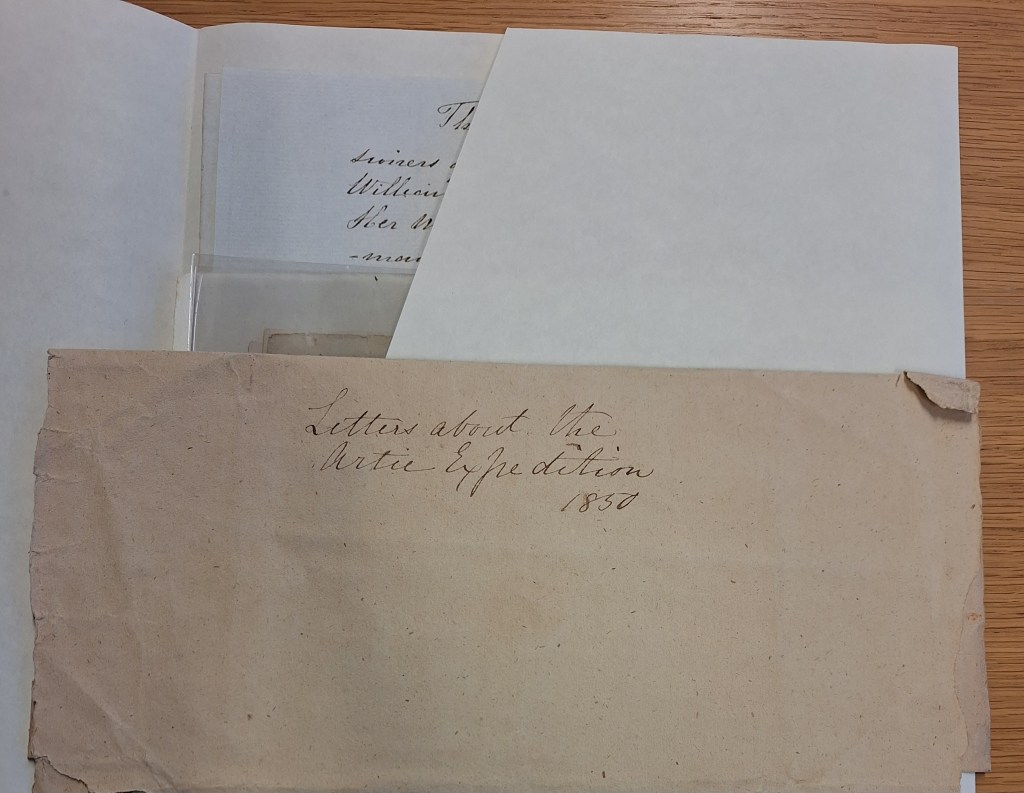
Unfortunately no such letters are anywhere to be found among Dobbie’s papers. The Caird Library says that this paper was the original wrapping paper that contained Dobbie’s recommendation letters and that “Letters about the Artic Expedition 1850” might refer to “one of the Dobbie family having collected general manuscripts and relics relating to naval history”. The Caird Library probably was not aware of Dobbie’s connection to Fitzjames. Would it not be a better explanation that Dobbie attempted to join a Franklin Expedition search expedition, or at least was corresponding about it? I will try to look into this.
To give you an idea of Dobbie’s personality, these are some anecdotes from Edward Charlewood’s Passages from the life of a Naval Officer (1869). Charlewood censored Dobbie’s name, but it is most assuredly him. Never a dull moment with Dobbie! He and Fitzjames would have been intolerable together with their pranks on HMS Excellent.
Intolerable plague
On board the “Excellent” we had a most singular character, named D- at that time a lieutenant. He was amazingly clever in mathematics, and could even pose our mathematical instructor. I believe no one has ever been appointed to the “Excellent” who could approach D – in this particular study; but in other respects he was cracked, and must have been an intolerable plague to all the officers under whom he served. He was exceedingly slovenly in his dress, and was constantly found fault with about it. One day his captain grew very angry with D-, for attending the morning divisional muster in a pair of white trousers high up above his ancles. The captain ordered him below to put straps on. D- obeyed, and when below he cut his trousers off just below the knee, leaving, however, two strips on either side of each leg, the width of straps; he afterwards sewed together the bottom of each pair of strips, and then hauled on his trousers. The bottom of the trousers now came to about the middle of his calf, and the remaining part of his leg had two long strips, the place where they were sewn together coming under the boot. In this state he came on deck again, with a demure face, as if he were not in the least aware of the absurdity of his appearance. The men and officers roared with laughter. The captain was very angry, and asked D- what he meant by it. D- replied that he really did not know what was now wrong in his dress, and that he had done his best to carry out the captain’s wishes. [p. 63]
While Charlewood thought that Dobbie probably was not very popular with his superior officers, the opposite turns out to be true. When Dobbie got into a “misunderstanding” with his Captain John Toup Nicolas on HMS Belleisle, the Excellent‘s Captain Thomas Hastings did not hesitate to write Dobbie a glowing recommendation letter. [DBB/107/2] After having received a letter from Dobbie, he replied on 9 March 1840: “I have no hesitation in complying with your wish that I should state my opinion of your conduct […] You conduct yourself on all occassions with obedience and respect to your Senior & Superior Officers – & I have no hesitation in stating that I should be most happy to have you as one of the Lieuts of any ship I might command […]” He ended the letter saying “I have […] the most entire reliance on the humble & truthful bearing of your mind. Accept my heartfelt wish that this storm may pass away without injury in your professional character.”
Egg
He played off a practical joke upon me, which was a most distressing one. Many of the officers had taken it into their heads to wash their hair with raw eggs. I never could fancy this, and persistently refused to adopt this plan. D- was determined I should. Accordingly, one day, when I was dressing with my back turned to the cabin door, D— quietly slipped in, and smashed an egg upon the top of my head ; but, horror of horrors! it turned out to be an intensely bad one. The stench was so intolerable I nearly fainted, and D- himself was little or no better. I was obliged to put my clothes into a bucket of water, and get myself soused all over to get rid of the offensive smell. [pp. 63-64]
Gunnery
We went to the Mediterranean , and before long the Syrian war commenced. Fitzjames and D- were gunnery lieutenants of two other line of battle ships in the same fleet, and this reminds me once more of D-. We were lying in Vourla Bay together, and one day seeing D- land on “Rat Island” with a large party of men to exercise small arms, I obtained leave to go and see him drill them. The moment I landed D- saw me, left his men, rushed down to meet me, his open watch in one hand, and with the other he took hold of my collar. “Come along, Charlewood, there’s not a moment to lose. ” With this he dragged me to the front of his men, who were drawn up in a long line. After waiting a few seconds, and noting the hands of his watch, he gave the order, “Quick march,” and away we went, D- still holding me by the collar, and I wondering what all this could mean. But we were not destined to march more than some twenty or thirty yards when I was horrified at seeing the earth suddenly spring up in front of us and thrown high up in the air, and then down fell a shower of earth and stones, which punished me and several of the men severely; still no one, I am thankful to say, was seriously hurt. This was Master D – ‘s method of teaching his men the power of gunpowder and the use of time-fuses. He had sunk a mine in the earth, charged it with powder, and then lighted a fuse attached to it, which allowed five minutes before exploding; and most correctly had he cut the fuse, for the mine exploded when we were just about fifteen yards from it. The sailors delighted in the fun, and charged over the debris in grand style, cheering away like madmen. [p. 65]
Ribbon
Upon another occasion, after the Syrian war, I found D-, as usual, in hot water with his captain. The Admiralty had given orders that the officers who had served in this war and earned a medal, should always, when in uniform, either wear the medal or a piece of the ribbon belonging to it. This was a fine chance for the length of the ribbon to be worn not having been specified. Accordingly, the following morning he appeared at divisions with a medal ribbon reaching from the lower part of his coat collar down to the last button hole! [pp. 65-66]
Despite his antics, Dobbie somehow managed to receive favourable recommendations from his Captains and he retired with the rank of Admiral. He passed away on 6 December 1889, and was buried a few days later on 11 December at St Swithun’s Church, Littleham.
These are the two other pictures of Dobbie, in the collection of the Caird Library [DBB/112]:


6 January 2024 – Fabiënne Tetteroo
 James Fitzjames