

Copyright: I like to share pictures of my collection for others to enjoy. If you reproduce pictures of my collection anywhere please credit me: ‘Collection of Fabiënne Tetteroo’.
Loose 1890s page from a carte de visite album with an illustration of an Arctic scene. I inserted my carte de visites of three Arctic veterans: John Hillary Allard, Sir Francis Leopold McClintock, and Sir George Strong Nares.


Subject:
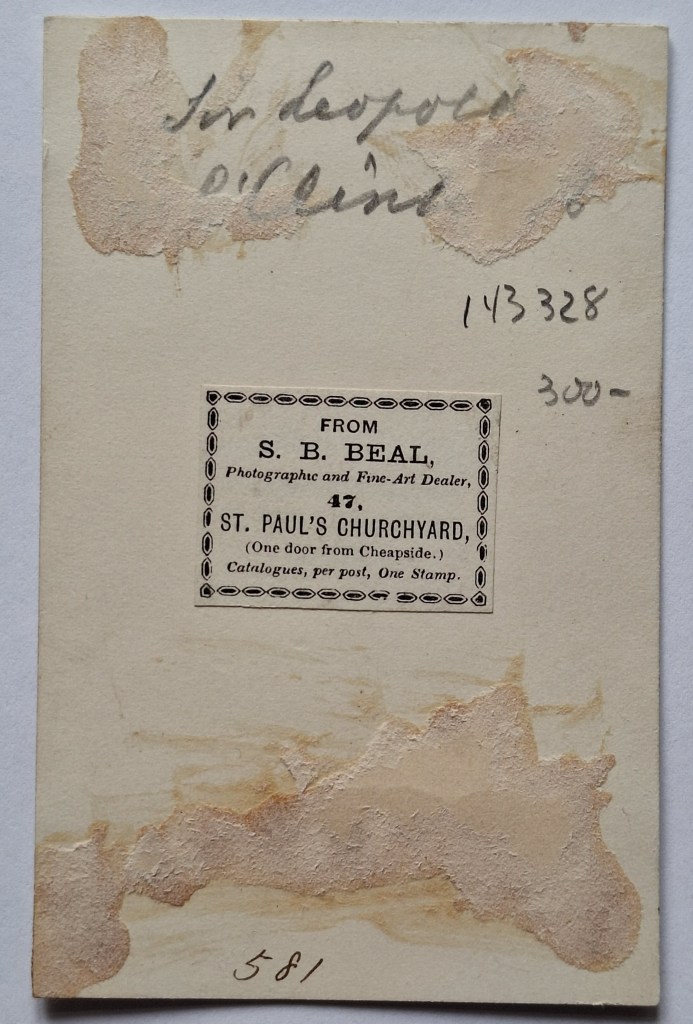
Sir Francis Leopold M’Clintock
M’Clintock is seen here in civilian dress identical to how he appears in the Illustrated London News engraving of his portrait published 1 May 1852 and again on 1 October 1859. The ILN engraving was based on a photograph by the studio of Richard Beard where M’Clintock is sitting on a chair, possibly the one he is standing next to in this carte de visite.
This card also appears in the following public collections:
- National Portrait Gallery, London: NPG x20199 (the NPG dates the picture to the 1860s)
- The Royal Collection Trust: RCIN 2911408 (acquired by Queen Victoria herself)
Photographer:
Unknown (possibly Richard Beard)
Date:
c. 1852?
Inscriptions:
Front:
Written:
Sir Leopold M’Clintock [looks like a 20th century addition]
Back:
– traces of having been glued to an album page.
Written:
Sir Leopold M’Clintock [contemporary?]
– 143 32/8 [photographer’s record number?] / 300- [price?]/ 581
Printed:
Sticker with on it:
“From S.B. Beal
Photographic and Fine Art Dealer,
47
ST. PAUL’S CHURCHYARD,
(One door from Cheapside)
Catalogues, per post, One Stamp.”

Subject:
Sir George Strong Nares (1831-1915)
A carte de visite in the collection of the BnF Gallica that seems to be a picture taken during the same photoshoot shows that the photographer is Cornelius Jabez Hughes.
This CDV does not appear to be in any public collections. The Wellcome Collection, London: Reference: 13290i has the same picture, but not as a CDV.
Photographer:
Cornelius Jabez Hughes
Ryde, Isle of Wight
Date:
c. 1872
Inscriptions:
Front:
Printed:
Captain Sir George Strong Nares , R.N., K.C.B.
Copyright J. Griffin & Co., Portsmouth
(Back of the card is blank.)


Subject:
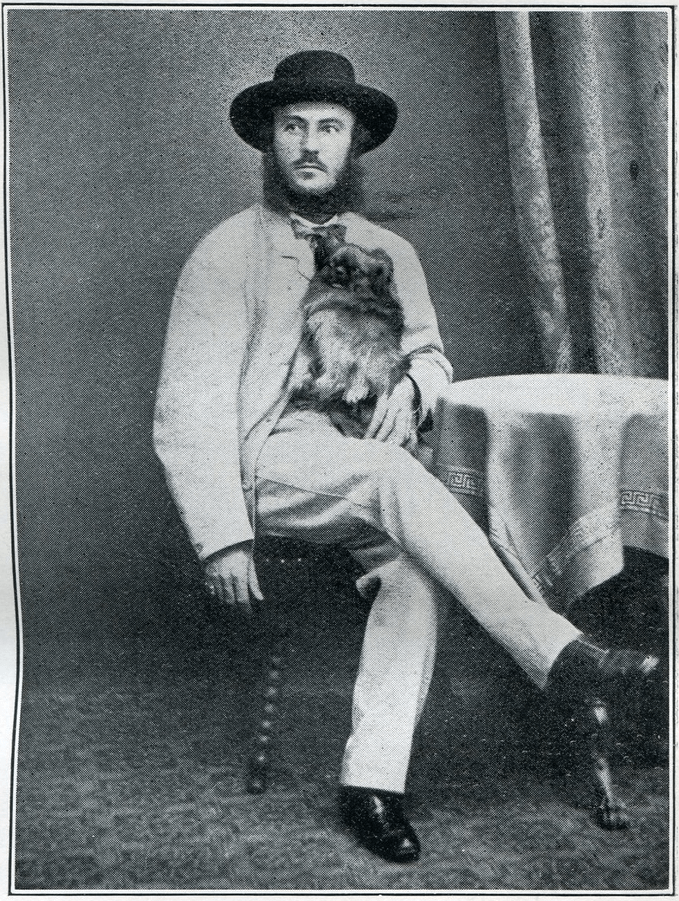
Lord John Hay (1827-1916)
John Hay joined the Royal Navy in 1839 and was in China during the First Opium War, on HMS Vestal according to Wikipedia. I am however not sure if Vestal was in China as this source places her in the West Indies and North America during that time.
Hay definitely served in China towards the end of the Second Opium War as Commander of HMS Odin (1859-1861). By then he had been Knighted for his services in the Crimean War in 1855. When I was looking for other portraits of Hay to compare my carte de visite to, I found a picture of Hay posing with a dog. This was not just any dog. This is one of the five Pekingese dogs that had been appropriated during the looting and destruction of the Imperial Summer Palace in Peking and brought to England to form the foundation of this breed in Britain and Europe [The Pekingese – A Complete Anthology of the Dog, 2013]. Hay got to keep two of the five dogs. He kept one for himself and gave it the unusual name Schlorff. The other named Hytien he gave to his sister Elizabeth, wife of the 2nd Duke of Wellington. Another of the Pekingese dogs was presented to Queen Victoria and given the dubious name Looty by the Queen.
Photographer:
Marcus Ward & Co
Date:
c. late 1860s/early 1870s [Marcus Ward & Co were located at 13 Donegall Place from 1855-1876 Note]
Inscriptions:
Front:
Written:
Lord John Hay
Back:
Printed:
Marcus Ward & Co
Photographers
13 Donegall Place
Belfast
Negative preserverd No.
Please quote the above number when ordering extra copies.


Subject:
George Alexander Waters (1820-1903)
According to his service record (TNA ADM 196/21/109), George Alexander Waters was baptised on 19 March 1820. He was born in Dublin, Ireland. His father Major Frederick Waters (1778-1845) was a Royal Marine who fought in the 1797 Battle of Camperdown. Note
I was excited to find a connection to Fitzjames. George Waters served as Master’s Assistant on HMS Vixen during the end of the First Opium War from 1842-1843. While Fitzjames ultimately got the command of HMS Clio, he was really hoping to get the Vixen as he wanted to command a steam ship. It would have put him on the same ship as George Waters. Fitzjames writes to John Barrow that the Vixen was the one to bring the officers of the Cornwallis the official news of their promotions on 16 March 1843.
While in China, George Waters managed to ‘obtain’ some religious objects that were later donated to the British Museum by his daughter-in-law.
He served during the 1857 Indian Mutiny, taking temporary command of HMS Shannon while her Captain Sir William Peel led the landing of a Naval brigade to the Siege of Lucknow. When Peel died, Waters took permanent command until the Shannon was paid off.Note
The picture in the carte de visite was taken when he was a Master on HMS James Watt from 5 March 1859 until 21 June 1862. The James Watt was part of the Mediterranean Station and is recorded as being in Naples Bay in 1861 in the magnificent painting below. [Sold by Charles Miller in 2020]
His last two commissions were Queen’s Harbour Master at Malta Dockyard (1871-1873) and Sheerness Dockyard (1873-1876). He retired with the rank of Captain on 25 July 1876.
Photographer:
Carlo Fratacci, Napoli
Date:
c. 1860-1862
Inscriptions:
Back:
Written:
George Waters
Printed:
Carlo Fratacci
Fotografo italiano
Vico Nunzio No 4 ulto po
Napoli


Subject:
HMS St Vincent (launched 1815, broken down 1906)
James Fitzjames served on HMS St Vincent when she was part of the Mediterranean Station from 1831 until 1834.
Photographer:
G. West & Son
Date:
c. 1862-1870 [St Vincent was moored in Portsmouth Harbour during that time, being moved to Haslar, Gosport in 1870]
Inscriptions:
Front:
Printed:
G. West & Son Gosport
Back:
Written:
HMS “St Vincent”
Printed:
– Artists & Photographers
G. West & Son
Eagle House
97 High St.
Gosport
– Marion Imp, Paris [Supplier of mounts]
Subject:
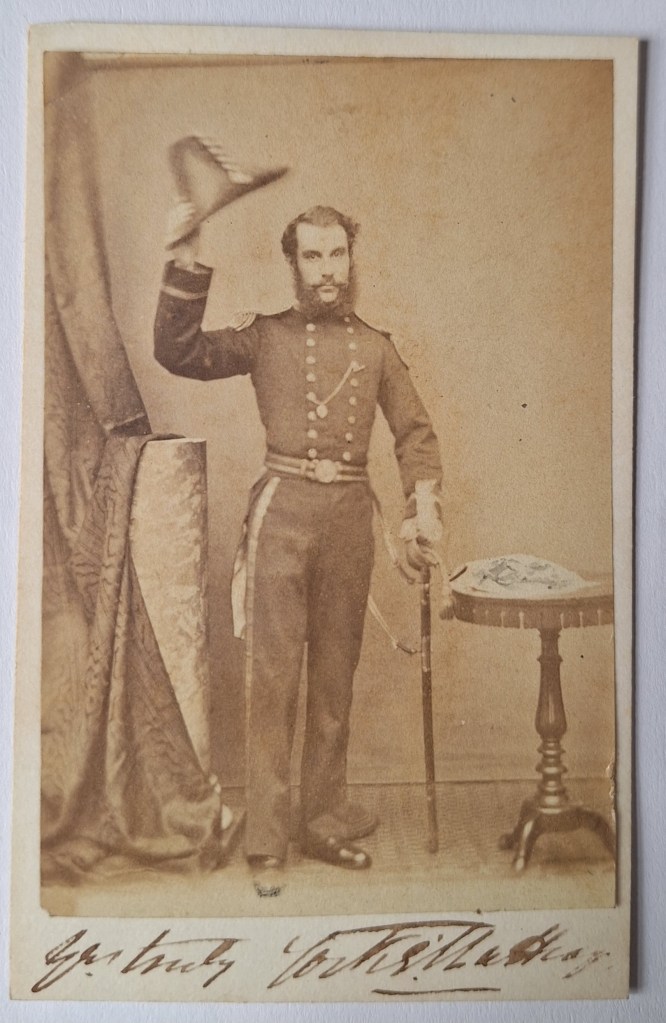
Grantham Yorke Runnygullian Rattray (1834-1897)
This fellow has a truly magnificent name. Grantham Yorke Runnygullian Rattray was born on November 18th 1834 in Barford, Warwickshire to Captain James Rattray RN and Emily Vivian Rattray.1 According to the 1841 census the boy went by the name Yorke, hence him signing the carte de visite as Yorke Rattray. Yorke had one older sister called Rosalie Sydney, who went by the latter name.2 Runnygullion refers to his great grandfather James Rattray of Runnygullion, a loyal Jacobite who fought at Culloden. Yorke’s father James Rattray fought at the famous Battle of Trafalgar on 21 October 1805, as Master’s Mate on HMS Britannia.3 The medal he received for this action is now at the Royal Navy Museum, Portsmouth.
The Rattray family lived in Barford House on Wellesbourne Road, a country estate with a substantial piece of land attached, which still stands to this day as a private residence. In 1858 James Rattray sold the estate and moved with his wife to 9 Hanover Terrace, London, which made them almost neighbours of John Barrow who lived at 17 Hanover Terrace.4 A few years later James Rattray died on 25 October 1862. According to the 1864 publication The County Families of the United Kingdom, 9 Hanover Terrace was Yorke Rattray’s ‘Town address’, so he got to keep his father’s house.5
Yorke was educated at Grosvenor College, Bath after which he went to the Royal Naval College, Portsmouth in 1848.6 His service record7 begins after he became a Mate on 15th June 1856 and shows him hopping from ship to ship, never staying on one ship for more than 6 months. He nevertheless obtains the rank of Lieutenant on 15th May 1858. After reading the following remark on his service record, one wonders how he managed this: “Very willing, very attentive, but deficient in ability & Seamanship“
But before 1856, Rattray was involved in something that piqued my interest: he served on HMS Amphitrite as Midshipman & Acting Mate during the two seasons she went on supply expeditions for the Franklin Search Expeditions in Bering Strait in 1852 and 1853. There is an album of watercolours made during this voyage by John Linton Palmer, Naval surgeon and artist: From Chile to the Arctic, at the RGS [F030/4]. The Amphitrite‘s muster [ADM 38/7519] tells us that Rattray was appointed from the Bellerophon on 6 November 1850. This is his signature in the muster [picture by Fabiënne Tetteroo]:
In 1854 Rattray was in HMS Pique during the siege of Petropavlovsk.8
The 1861 census has him on board HMS Caesar, on which he served for almost two years. His next commission would be the one he held until his retirement: from 12 April 1863 he was Chief Officer of the Coast Guard on the Isle of Wight.9 On 2 June 1863 he married Charlotte Adcock at St. John’s Church, Paddington. This is their marriage record10:
On 12 May 1864 their first child James Vivian Yorke Rattray was baptised in Brook, Isle of Wight and on 4 April 1869 their second and last child Charlotte Eva was baptised in Holy Trinity Church, Cowes, Isle of Wight.
The 1871 census11 shows the family living at the Coast Guard Station in Brook. According to a remark in his service record, he was thanked by the National Lifeboat Institution for his assistance in a lifeboat on 10 February 1872.12 Yorke Rattray retired from the Navy as a Commander on 1 October 1873.
We get a glimpse of Yorke’s personality in this article about a benefit he organised on 13 January 1883, where he sang a comical song and danced: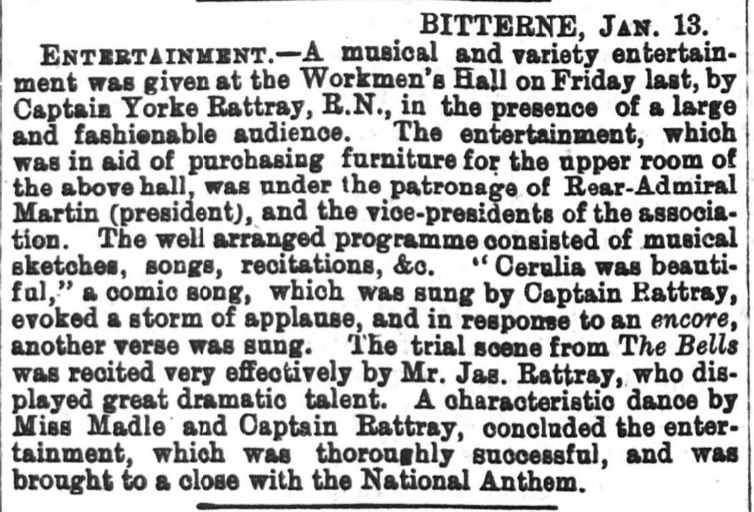
The chorus of ‘Cerulia [or Cerulea] was beautiful‘ goes like this:
” Cerulea was beautiful, Cerulea was fair,
She lived with her gran ‘ma
In Gooseberry Square.
She was once my unkydoodleum,
But now, alas, she
Plays kissy-kissy with an officer
In the artiller-ee.”Note
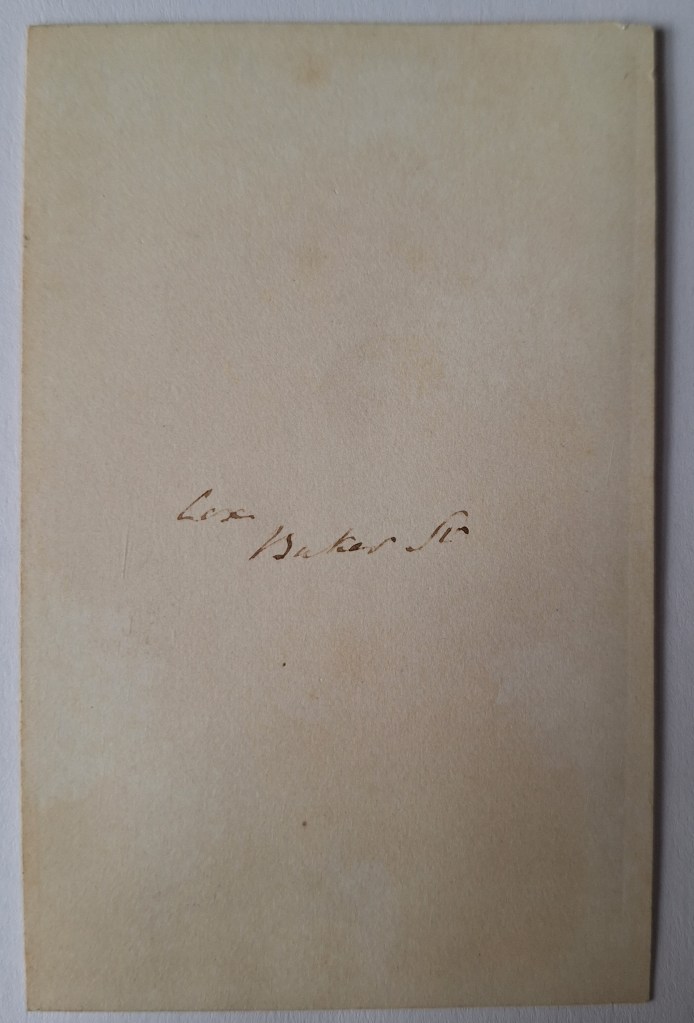
His son James Rattray did not follow in his father’s and grandfather’s footsteps and according to his 1884 marriage record13 became an electrical engineer. On this same record his address is listed as “Upper Baker Street”. Is this connected to the Baker Street written on the back of the carte de visite? The carte de visite comes from the collection of Annie Allard, John Hillary Allard’s daughter. Perhaps Rattray and John Allard knew each other, and Rattray gave his picture as a token of friendship.
Yorke Rattray died suddenly on 17 February 1897 from “heart disease” while he was staying in Brighton at 40 King’s Road. He is buried at Northwood Cemetery, Cowes, Isle of Wight together with his parents.14

Footnotes
1. DR0129/1, 1813-1844, p. 64, Warwickshire County Record Office (via findmypast.co.uk)
2. 1841 England, Wales & Scotland Census (via findmypast.co.uk)
3. William Richard O’Byrne A Naval Biographical Dictionary, Rattray, James
4. 1861 England, Wales & Scotland Census (via ancestry.co.uk)
5. Edward Walford The County Families of the United Kingdom, Or Royal Manual of the Titled and Untitled Aristocracy of Great Britain and Ireland; Containing a Brief Notice of the Descent, Birth, Marriage, Education, and Appointments of Each Person, His Heir … Together with His Town Address and Country Residence, 1864, p. 384
6. Idem.
7. ADM 196/70/449, The National Archives
8. Army and Navy Gazette – Saturday 20 February 1897
9. ADM 196/14/185, The National Archives
10. P87/JNE1, Item 015, Saint John The Evangelist, Paddington, Register of marriages, London Metropolitan Archives, (via Ancestry.co.uk)
11. 1871 England, Wales & Scotland Census (via ancestry.co.uk)
12. ADM 196/70/449, The National Archives
13. p89/ctc/082, London Metropolitan Archives
14. Isle of Wight County Press – Saturday 27 February 1897
Photographer:
Unknown
Date:
c. 1858
Inscriptions:
Front:
Written:
Yrs truly Yorke Rattray
Back:
Written:
Lex[?]
Baker Str
Provenance:
Collection of Allard family


Subject:
Prince Alfred (1844-1900)
The second son of Queen Victoria and Prince Albert entered the Royal Navy in 1856. In this picture he is wearing the uniform and insignia of a Captain, to which rank he was promoted in 1866.
This card also appears in the following public collections:
- National Portrait Gallery: NPG Ax131365 (different mount from mine)
Photographer:
The London Stereoscopic & Photographic Company
Date:
c. 1866
Inscriptions:
Front:
Printed:
Stereoscopic Cny
Copyright
Back:
Printed:
Photographers to H R H The Prince of Wales
Sole photographers to the Intenational Exhibition 1862
The London Stereoscopic & Photographic Company
110 & 108, Regent Street
and
54, Cheapside


Subject:
Prince Alfred (1844-1900)
This picture of Prince Albert was taken when he was a Midshipman. There are Naval attributes on the table next to him: a telescope, a map, and a cap.
Multiple pictures were taken that day, with a variety of poses. This cabinet card version is particularly nice and shows the objects very clearly:
https://www.npg.org.uk/collections/search/portrait/mw126681/Prince-Alfred-Duke-of-Edinburgh-and-Saxe-Coburg-and-Gotha
Photographer:
Mayall
Date:
c. 1860
Inscriptions:
Front:
Blank
Back:
Printed:
Photographed from life by
Mayall
224, Regent Street
London
Written:
Prince Alfred

Subject:
Royal Navy Commander
There is no name inscribed on this card, so unfortunately no way of identifying this man. The medal he is wearing looks to be the Baltic Medal.
Photographer:
Poate & Co, Portsmouth
Date:
c. 1863
Inscriptions:
Back:
Printed:
Photographic Institute
Poate & Co
Pembroke St. No 2
Portsmouth
Written:
P178675

Subject:
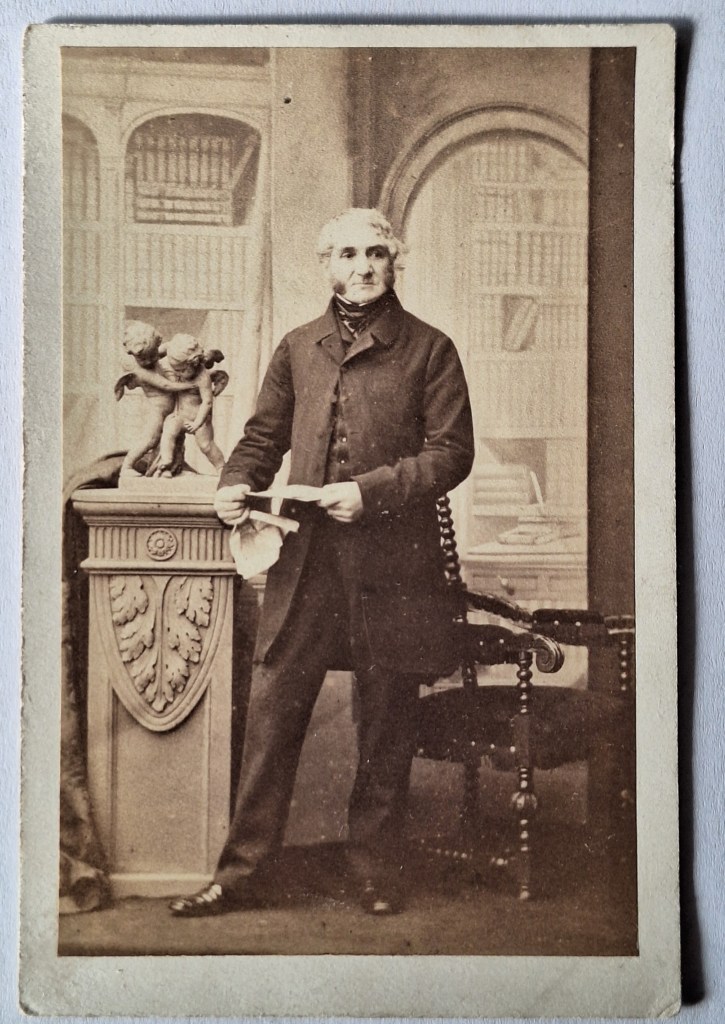
Vice-Admiral Sir Richard Saunders Dundas (1802-1861)
Dundas was the Captain of HMS Belvidera on the Mediterranean Station from November 1830 until December 1833 when James Fitzjames was there too in HMS St Vincent and Madagascar. John Irving, who later went on the Franklin Expedition with Fitzjames, was a Midshipman on the Belvidara from 1830 until December 1833 when the ship was paid off.
Fitzjames mentions the Belvidera a few times in his journal [JOD/86, Caird Library, NMM]:
“Wednesday 17th [April 1833]. Champion came in from Tripoli
with the news of a Lieut and Marine officer
of the Belvidera having been drowned —
[…]
Friday 3rd [May 1833]. Arrived the Belvidera from Tripoli
[…]
Sunday 19th [May 1833]. Went ashore + Arrived Rapid
Kept it up with the Belvidera’s till 4 in the morning
Monday 20th [May 1833]. Sailed the Belvidera with
Lady Frances Hotham for England —”
Years later, on 27 January 1844, John Irving wrote to his friend William Elphinstone Malcolm about a meeting with Dundas: “I met Captain Dundas in London; he was very kind. I have never met his equal since. He was in all respects a perfect officer and gentleman.” [Lieut. John Irving, A Memorial Sketch With Letters, p. 97]
This card also appears in the following public collections:
- National Portrait Gallery: NPG Ax50830
Photographer:
Camille Silvy
Date:
1860
Inscriptions:
Back:
Printed:
Photographed by C Silvy
38, Porchester Terrace
Bayswater. W
Written:
Admiral Dundas

Subject:
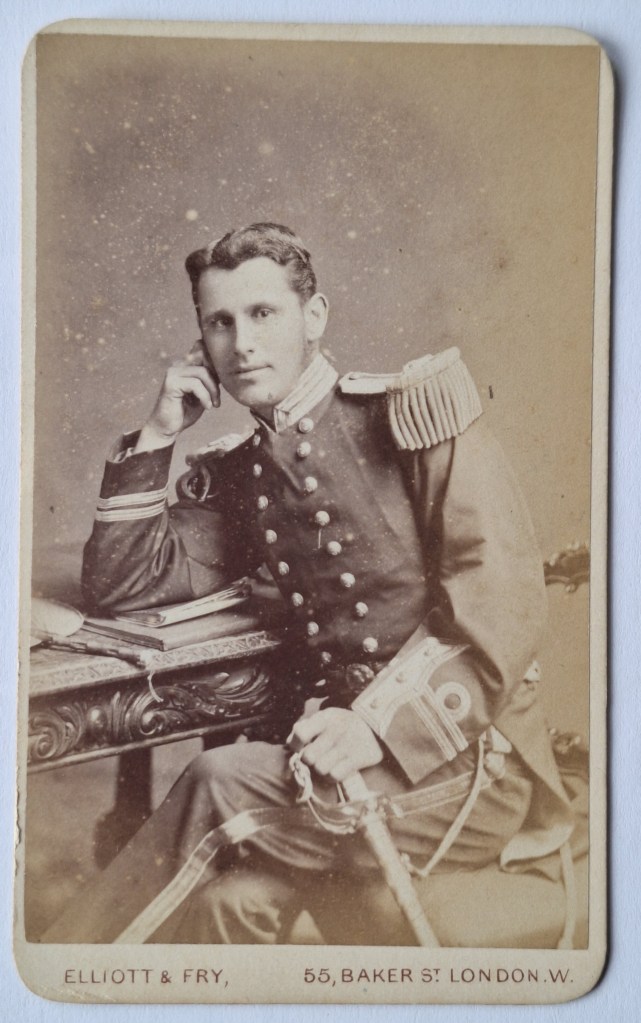
Navigating Lieutenant James Henderson
According to the handwritten inscription on the back of the card, this is J. Henderson of HMS Fox, 1874-1878. A search in the National Archives revealed the service record of a James Henderson (born 5 October 1846 – retired 1902) who indeed served on HMS Fox from 21 August ’74 until 25 April 1877 (the card inscription incorrectly says until 1878). [The National Archives, ADM 196/73/177] Since 1867 Navigating Lieutenant was the new name for the rank of Master.
Photographer:
Elliott & Fry
Date:
c. 1874
Inscriptions:
Front:
Printed:
Elliott & Fry 55 Baker St London. W.
Back:
Printed:
– Elliott & Fry
55, Baker Street,
Portman Square,
London.
W.
– No:
– Marion Imp, Paris [Supplier of mounts]
Written:
– Nav-Lieut J. Henderson
HMS Fox 1874 to 78
– 28750
Provenance:
Collection of Allard family

I acquired these photographs taken at the Grillet studio in Naples all together. French photographers Claude Victoire Grillet and Jean-Louis Grillet were active in Naples since the early 1850s and it was the latter’s daughter Jeanne who founded the photography studio.Note
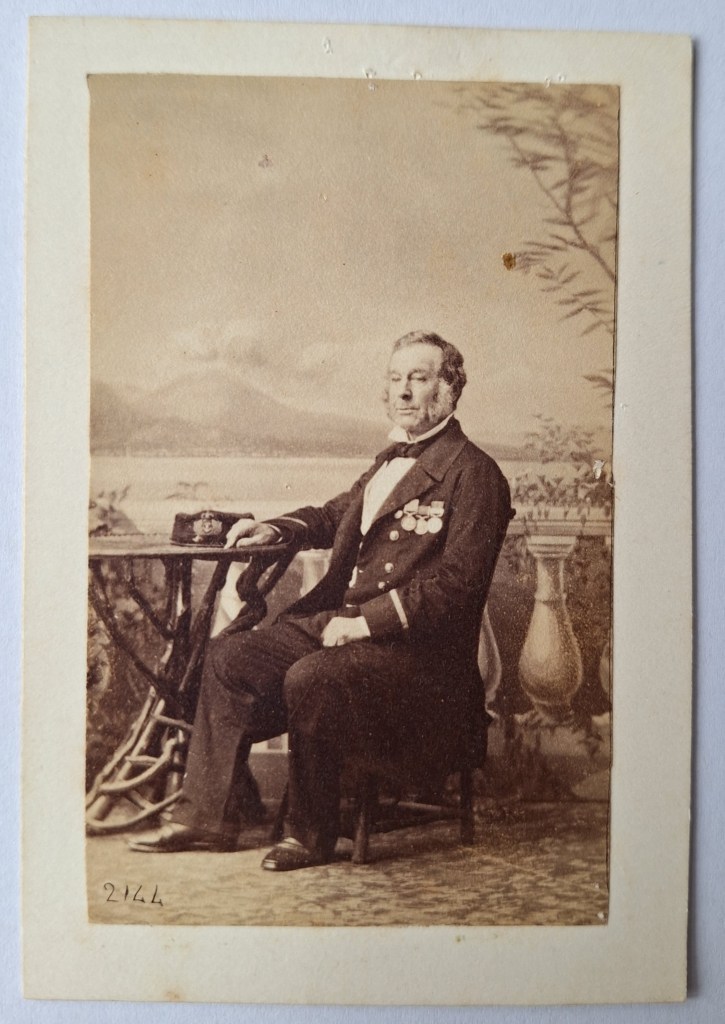

Subject:
James Harvey
Photographer:
Grillet Jr
Date
1861
Inscriptions:
Front:
2144
Back:
Written:
Jas Harvey [?] 1861
Printed:
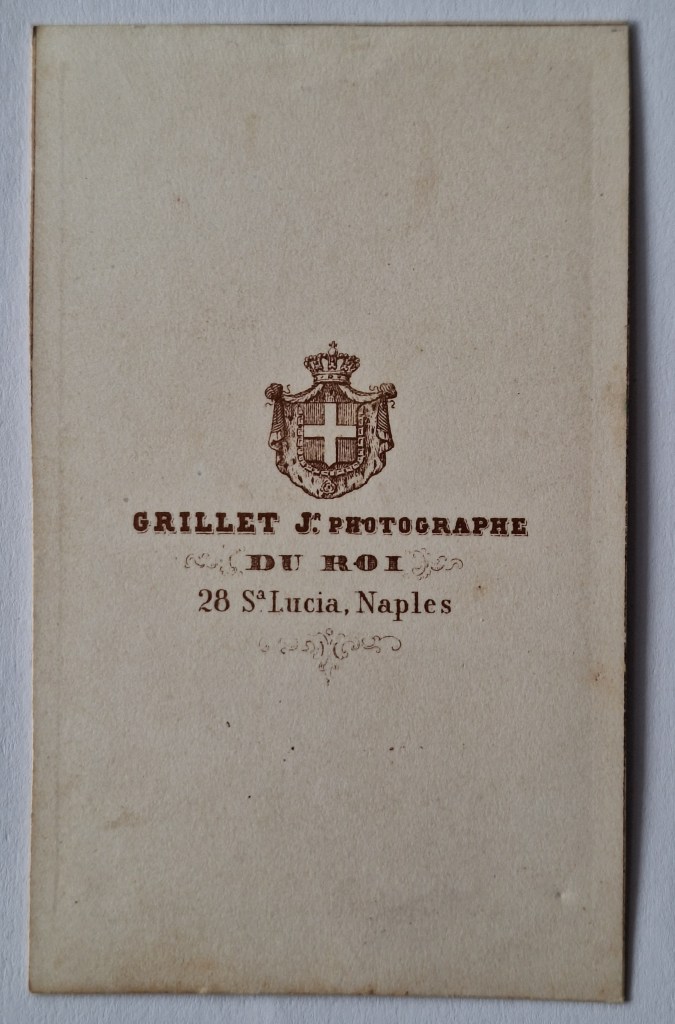
Grillet Jr Photographe
Du Roi
28 Sa Lucia, Naples
Provenance:
Collection of Allard family


Subject:
Sub-Lieutenant H.S. Jenkings [?]
Photographer:
Grillet Jr
Date
October 11th 1861
Inscriptions:
Front:
2168
Back:
Written:
H.S. Jenkings
Oct. 11th 1861
Printed:
Grillet Jr Photographe
Du Roi
28 Sa Lucia, Naples
Provenance:
Collection of Allard family
Subject:
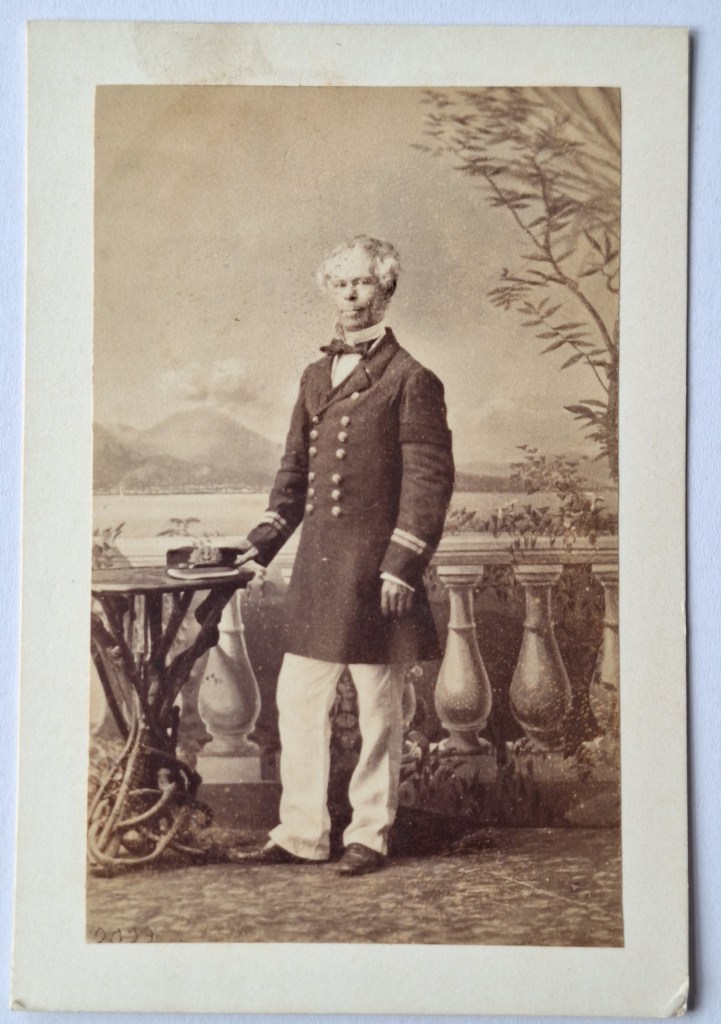
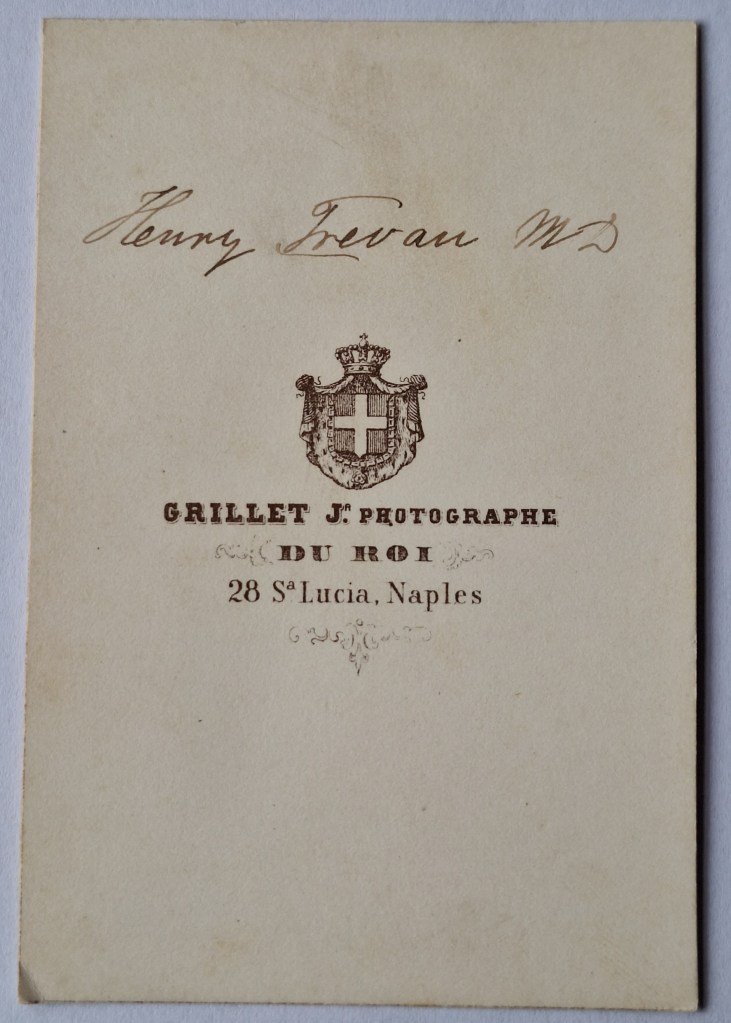
Henry Trevan MD (c.1808-1880)
According to his service record [TNA ADM 196/8/658], Henry Trevan was born on 23 July 1813. (I automatically think “that’s 4 days before Fitzjames was born!”) This might however not be a correct date of birth. When you search the Admiralty service records for “Henry Trevan” there is only one result, and there is a grave of a Henry Trevan, Fleet Surgeon, where it says he was born 26 December 1808. Note I cannot find a baptism record for Henry, but perhaps the date on his service record is actually the day he was baptised.
His parents were John Archer Trevan and Ann Trevan née Watts, who lived in the parish of St Endellion, Port Isaac, Cornwall. John was Principal Coast Officer of Customs and Ann was the daughter of a local merchant.
They had 10 children, of whom three became doctors (Frederick, Matthew and Henry). Frederick settled as a doctor in Port Isaac (his house Trevan House is now for rent as a holiday home) and he wrote The History of Port Isaac and Port Quin in which he also gives details about his family.
Henry received his medical education at St Bartholomew’s Hospital in London, graduating in 1836. Note That same year he joined the Royal Navy as Assistant Surgeon on HMS Royal Adelaide. He was promoted to Surgeon in 1846 after which he joined HMS Favorite.
From 25 April 1859 until 14 October 1862 Henry served on HMS Exmouth as part of the Mediteranean Station. The Exmouth was indeed in Naples Bay in 1859 and 1861. Note Perhaps Henry had his picture taken to commemorate his promotion to Staff Surgeon on 2 October 1861?
Henry Trevan retired from the Navy in 1870, after which he served as a Magistrate in Cornwall. His life ended rather tragically on 19th July 1880:

Photographer:
Grillet Jr
Date
c. 1859-1861
Inscriptions:
Front:
2099
Back:
Written:
Henry Trevan MD
Printed:
Grillet Jr Photographe
Du Roi
28 Sa Lucia, Naples
Provenance:
Collection of Allard family


Subject:
Sub-Lieutenant Charles John Balfour
While the back of the carte de visite seems to say Charles Geo[rge] Balfour, there is a Charles John Balfour (born 3 October 1841) who was on HMS Exmouth from 1859 until 1862. He was promoted to Sub-Lieutenant on 10 December 1861, the year the photo in this carte de visite was taken. There is an extensive biography to be found here.
Photographer:
Grillet Jr
Date
1861
Inscriptions:
Front:
2331
Back:
Written:
Chas [Geo?] Balfour 1861
Printed:
Grillet Jr Photographe
Du Roi
28 Sa Lucia, Naples
Provenance:
Collection of Allard family


Subject:
Midshipman J Proeter[?]
Photographer:
Grillet Jr
Date
1861
Inscriptions:
Back:
Written:
Septr 1861
Printed:
Grillet Jr Photographe
Du Roi
28 Sa Lucia, Naples
Provenance:
Collection of Allard family
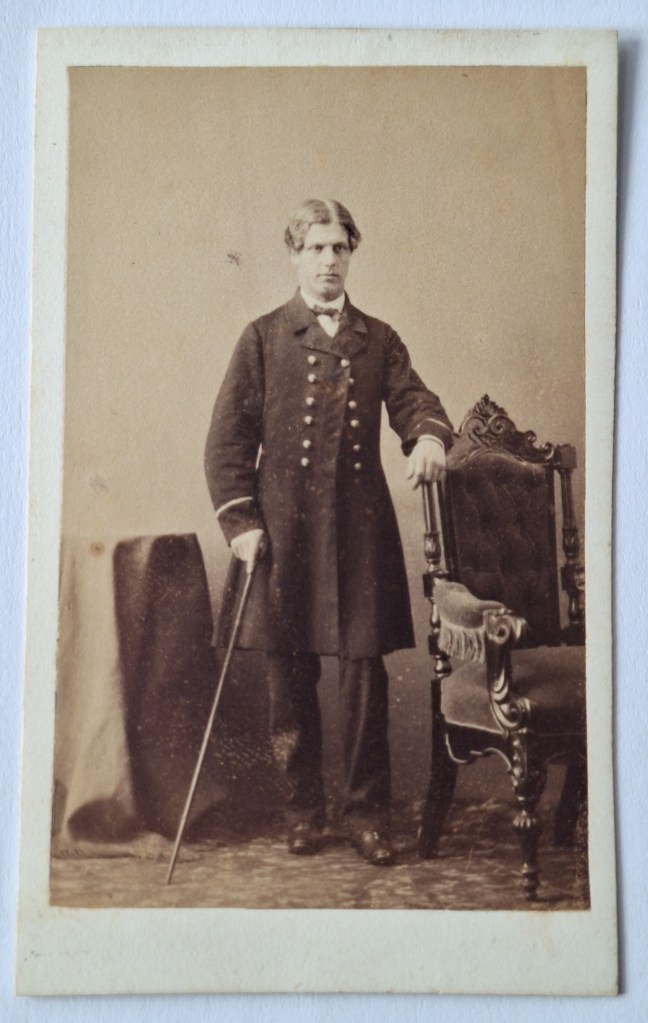
Subject:
Royal Navy Warrant Officer
There is no name inscribed on this card, so unfortunately no way of identifying this man.
Photographer:
Grillet Jr
Date
c. 1860
Inscriptions:
Back:
Printed:
Grillet Jr Photographe
Du Roi
28 Sa Lucia, Naples
Provenance:
Collection of Allard family
 James Fitzjames